Sunday, September 24, 2006

I’ve been to four ACFW conferences since joining in 2002. Some have been good, others…well, not so much. Dallas proved to be a far different experience. I arrived on Wednesday, expecting very little beyond my appointments, though it was my hope that author Jane Orcutt, who’d agreed to do a paid critique with me, liked the chapter I’d sent. Little did I know how wonderful this would prove to be—to go with no expectations and let God do the work He wants to do.

I felt the quiet buzz the moment I walked into the hotel lobby. Conferees occupied the seating areas and spilled out into the halls. No one wore name tags yet, but their faces spoke hope and excitement that immediately set them apart as writers, here for a purpose. All around me, I felt the warm embrace of people like me, kindred spirits with a love for writing and a love for the Lord. Also present were those conference newbies, eighty-nine in all. First timers with a look of fear on their face that brought me back to my first conference experience. I reached out to them, just as someone had reached out to me, and felt the thrill of helping make Dallas a wonderful experience for someone else.

Anticipation made sleep elusive that night. I’d memorized my ‘one-liner,’ and planned to read off my pitch sheet during my appointments. While I did not feel the same nervousness as I had at previous conferences, there was still that ‘waiting’ that accompanies every attendee. I awoke Thursday, eager to begin. Unfortunately, my appointment with Jane was postponed until Friday. This ended up being a blessing, though I only realized that later.

Our keynote speaker that night, Liz Curtis Higgs, was awesome. Her message will stick with me. I wish I could carry her around in my pocket, and take her out from time to time for encouragement. The worship sessions were wonderful, a place of praise and healing. Joy shone from people’s faces as they sang. From that point on, I knew I had a great conference in store.

I rose Friday morning, encouraged by Lizzie’s (as she referred to herself) speech, and ready to face my first appointment. Jane met me in the hotel lobby. She prepared me for my meeting with Melissa Endlich, Steeple Hill editor, much like a cheerleader, pushing me from the sidelines with her encouragement and enthusiasm. She helped me hone my pitch, stressing the things I needed to bring out, even offering to do my pitch for me when I told her about my aversion to the silly things. I was floored by her outpouring of compassion and generosity. Forgive me, Jane. Even this little bit does not fully express how much your kind actions meant.

Immediately following my appointment with Jane, was Melissa Endlich. Funny how editors and agents are just like real people. They weren’t nearly as scary as I’d always made them out to be. For the first time, I saw them as friends, people just like me, who understood my nervousness and fears and wanted to help. While I can’t say it went without a hitch, it was encouraging to receive a request for a full manuscript. This, I know, was in part, thanks to Susan Downs’ gift of “Barbour Mystery Author” which each of us stuck to our name tags. I doubt that Susan realized as she labored over these small tokens, how many doors would be opened to us as a result. Thank you, Susan. You are a priceless gift.

Just when I thought the conference couldn’t get any better, Liz Curtis Higgs addressed us again, right after lunch on Saturday. Her message of hope and healing inspired me, touched me, moved me to tears. I’m scared to death to put my heart into my writing, but she taught me the importance of daring to try.

“God doesn’t waste anything,” Liz said. “He uses your sins and your hurts.”

Readers want to feel connected with my words. Unless I am brave enough to bare my soul, I cannot hope to change a reader’s heart, or help them heal a hurt. Thank you, Liz, for challenging me beyond what I thought I was able.

Saturday night—awards banquet. We celebrated the joys and excitement of the Book of the Year finalists, the Genesis finalists, and the Mentor of the Year. Congratulations to you, Colleen Coble, for having your book, Distant Echoes, named as the ACFW Book of the Year. Lena Nelson Dooley won Mentor of the Year, and after having spent time with her, it was easy for me to understand why. Lastly, I want to thank Marian Merritt, a dear friend that I met at last year’s conference, for giving me something to celebrate as she was named the Genesis winner for 2006. Congratulations, lady. I know it was well deserved.

We’re on our way home now. My immediate plans are to get right to work finishing the revisions on the manuscript Steeple Hill has requested. I’ve also got a proposal to send to agent Wendy Lawton. Hopefully, six months from now I will have heard from them both, and I’ll have two more things to celebrate as I lay plans for 2007. If you weren’t there this year, we missed you. Hopefully, things will be different next year, and we can all say, “See you in Dallas.”
Sunday, September 17, 2006

I went into my first conference without the benefit of a mentor. Choosing my editor/agent appointments was interesting, to say the least. At most, it was hit or miss. Thankfully, God was with me as, with fingers shaking, I made my selections.

The next two years, being much more informed (grin), I researched each editor/agent carefully, perused and pored over each publisher’s guidelines, and with fingers shaking, I made my selections. Somehow, I still got the feeling that it was hit or miss.

What makes this year different? Time and connections.

It’s not enough to check out a publisher’s website for guidelines. I’ve discovered that one of the many valuable assets to attending writer’s conferences is the things you learn in the hotel lobby, or the even the bathroom! People talk, mostly about which house acquiring, and who sold what to whom. This stuff is invaluable, folks.

The editor/agent panels are also wonderful tools when used correctly. Take notes! Though the business can change over the course of a year, much of what you learn regarding a house or agency remains the same, even a particular editor or agent moves on.

And don’t overlook writer’s loops. Even casual conversation can be important. When someone announces a book sale, I’m careful to examine what they sold, and who they sold to. Several times, I’ve been surprised to learn that a house I didn’t think was acquiring historicals, for example, bought not one, but a series, and so on.

Sound like an involved process? That’s because it is. In a nutshell, scheduling your editor/agent appointments is the culmination of a year long process of researching, listening, and asking questions, but don’t be dismayed if you’re just now getting started. ACFW is wonderful about updating news and information before the conference begins. The next step will be to start planning for 2007’s conference, the day after this one begins.

Saturday, September 09, 2006


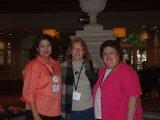
Every year, come September, I pack my bags and head to one of the best writer’s conferences in Christian fiction—the annual American Christian Fiction Writer’s Conference. I'm pictured above with two of my critique partners at last year's conference in Nashville. With so many conferences to choose from, why did I pick this one? It’s simple. The fellowship!

God really knew what He was doing when He pointed me toward my first ever conference, held four years ago in Houston. I’d have been overwhelmed if my first ever experience took place at Mt. Hermon, or some huge gathering like that. Instead, my first conference consisted of about 150 attendees, including staff, a few editors, and agents. I learned the ropes alongside other newbies, in the ease and assurance of a handful of bright writers with a penchant for encouraging others. It was there that I learned the value of networking, and the necessity of honing my craft. To state it plainly, I learned how much I didn’t know.

The ACFW conference has grown somewhat. At last count, over three hundred writers, publishers, and agents had signed up to attend. On top of that, I will, for the first time, be attending as a published author.

Wait.

If the point of going to a conference is to get published, then why am I going? Simply because my biggest discovery at last year’s conference, held in Nashville, was not which house was acquiring, or which agents were accepting clients. My biggest discovery was how important the passage to publication could be.

“Don’t be so focused on the goal,” our keynote said, “that you miss the journey along the way.”

That’s my paraphrased version. Forgive me if I didn’t get it exactly right. Regardless, I suddenly understood that the importance of the ACFW conference was not the meetings, appointments, classes, or contacts. The importance was in the journey, in all the little things God would teach me along the way. The conference has taught me how to reach out to other writers. It has taught me to strive for my dreams, and not fear the failures. I’ve learned to share in the triumphs of others, and witnessed firsthand that I am not alone in my heartaches.

In a nutshell, there is much to be learned at the ACFW conference in Dallas. I’ll attend the classes, and meet with editors. I’ll pitch, and propose, exchange business cards, and stay up late chatting. I’ll meet new people and learn how the business has changed in a year.

But it’ll have nothing whatsoever to do with a contract.

Sunday, September 03, 2006

The excitement. The euphoria.

For months I planned, plotted, and prayed. Hands shaking, I packaged my proposal and dropped it in the mail—scant hours to spare before the deadline for submitting arrived. Breathless, I sat back to wait.

Finally, it came. The request for a full manuscript. Heart pounding, I polished and shined my story, then packaged my novel and dropped it in the mail—scant hours to spare before the deadline arrived. Breathless, I sat back to wait.

Months passed. I sought God for an answer. When it came, I wasn’t prepared.

The rejection.

Weeks of waiting and hoping, begging and praying. All for naught, or so it seemed. I cried—despaired of ever seeing my dream realized. But somehow, after a few days, I managed to start writing and the process of submitting and waiting, hurrying and delaying, started all over again.

Somehow, I thought it would be different after the contract. Somehow, I thought that slip of paper would change the process, shorten it perhaps, so that the waiting wasn’t so excruciating.

Not so.

Being contracted only adds to the things being waited for. Now that the book has been submitted to my editor, I wait with anticipation to hear what changes will be required. I look forward to the day that I’m presented with galleys. I long for the day when I peruse cover art and graphic designs. I can hardly wait until I hold my book in my hands.

All of this makes me think that perhaps it’s a lesson in patience that God is trying to teach me. Perhaps the waiting isn’t so terrible, since it’s in those times that I am still, and God’s voice is most clear.

So what has my lesson in patience taught me? I’ve learned the day I wrote, “The End. . .” that was really the beginning.

Next week: The Conference

Saturday, August 26, 2006

Rather than a figurative line floating somewhere in the romantic notions of aspiring authors, deadlines are really dates, given by the publisher, for when a manuscript is due.

Sound a little less like the fairytale?

Janelle and I thought so, too, especially when we realized that with more than twelve chapters left to write, our deadline was only eight weeks away. Added to that, the pressure of preparing for the American Christian Fiction Writer’s conference, held every year in September, loomed heavy over our heads. Both of us have other manuscripts we want to pitch, so finishing this book early became doubly important. In order to conserve time, we decided to put aside the editing for a bit, and concentrate on getting the story down on paper. . .er. . .computer.

Funny thing is, the rest of the world didn't stop simply because we had a deadline. There was still home, work, and family, to deal with, not to mention VBS! How did we do it? I found myself spending a lot less time answering emails and surfing the internet, for one thing, but the biggest time saver of all was simply turning off the t.v. and forcing myself to write, even it was only a page or two each night.

The days and chapters flew by as we scrambled to get the writing done and still give ourselves and our crit groups ample time to critique. Thankfully, they were understanding and agreed to look over large portions of the manuscript in order to help us meet our deadline. That did not, however, mean less to change. Like any good crit group, my partners are dedicated to helping me put out the very best novel I can, which translated to minor, but necessary revisions. I didn’t mind. Better them, than my editor.

Once the novel was complete, Janelle and I got together to apply the final edits. Both of us could realistically be accused of being perfectionists. She is very detail oriented, and I am nit-picky when it comes to editing, so we prepared ourselves for a long day of hard work. The entire process took nearly ten hours, but we were satisfied with the finished product and managed to submit the book with four weeks to spare.

Next week: Hurry up and Wait

Saturday, August 19, 2006

So Janelle and I decided to co-author.

Seemed like a simple enough venture when we started out. Barbour announced their new mystery line and it seemed the perfect opportunity. But when the contract was signed, the real work of submitting a polished manuscript began.

For anyone considering co-authoring, I would caution you to choose your partner carefully. How well do you know the other person? How familiar are you with his or her work? Besides being co-authors, Janelle Mowery and I have been critique partners and friends for almost five years. She knows my work inside and out, as I do hers. Our styles are similar. We hold many of the same values and beliefs, which is vital when writing inspirationals. All of this will combine to either make or break a duo, no matter how dynamic they are.

Honesty is also important. Janelle and I have always been open with one another, speaking the truth in love when something works in a manuscript and when it doesn’t. This gave us a good foundation for developing a deeper working relationship, especially since we were planning for an extended term.

Long before the actual writing, we began plotting the story via telephone and emails. Communication is key, so be sure you correspond often and in length with your co-author. This will help you avoid troubling issues when the story takes an unexpected turn.

Once we came up with a good premise, timeline, and a detailed synopsis, we took time out to find headshots of our characters so that we could both visualize them clearly. THEN we began writing. Even with the advance prep work, this was no easy task. We determined to each take a POV character, but we both had very clear ideas of what the other’s character would be like, which meant a lot of issues had be worked out before and during the writing process. Once again, knowing your partner is crucial so that disagreements can be resolved calmly through compromise.

And that was just chapter one. :-)

The first major hurdles behind us, Janelle and I quickly got into the story. Over the next few weeks, we took turns writing and submitting chapters, sending them back and forth, editing and critiquing each other until we were both satisfied. Did I mention the need for compromise? Be prepared to work out the kinks when your co-author doesn't envision a scene the same way you did, and be willing to accept that their idea may be better than the one you came up with. The beauty of co-authoring really is the old adage, "two minds are better than one."

Afterward, make use of critique partners. We belong to two fantastic crit groups. Even though Janelle and I picked apart and perused every chapter, they were still able to offer suggestions and make recommendations that served to strengthen our work. We met face-to-face in order to review the critiques and decide which changes to apply. This became even more valuable as the time for submitting the manuscript to our editor drew near.

Next week: The Deadline

Sunday, August 13, 2006


“Mom, I sold a book.”

I still remember the excitement I felt as I spoke those words. After seven years of learning, writing, submitting, and being rejected, I’d finally sold a manuscript. At long last, the hard work and tears had paid off. I could officially and without reservation, add AUTHOR to the signature line on my emails. Hey, it’s the little things, right?

Anyway, my mom was thrilled. For almost half a minute, she just laughed and repeated over and over how proud she was of me. She asked when the book would come out. She asked about the publisher. And, eventually, we got down to the nitty-gritty.

“So? How much do you get?”

“Huh?”

“The money. How much do you get?”

“Um…”

You know, before I joined the American Christian Fiction Writers (ACFW), I was under the mistaken impression that people who wrote books owned expensive cars and lived in crystal palaces with servants to cook their food and clean their bathrooms. Okay, I wasn’t quite that naïve. Not quite.

I tried to explain that I was a new author, that it was the sale that mattered. After she got over the initial shock, Mom remembered that she was proud of me, and that she could tell all her friends she has a daughter who is published. I think that, and the fact that the royalties go up considerably for reprints, made up for the rest.

Mom finally found her voice. "I'm happy for you, hija (daughter). Just be sure you read the contract carefully."

Carefully? My husband and I perused the contract for days! Certain parts jumped out at me, things like, "Grant of Rights," and "Delivery of Manuscript." Suddenly, I realized there was a whole lot more than I thought to this whole "Publishing Agreement" thing. By putting my name to paper, I was signing over rights to a novel I had prayed and sweated over for months. Not only that, I was bound to deliver said novel, described within the publishing agreement as the "WORK" by a clearly outlined deadline.

Why do they refer to it as the "Work?" I wondered. And then I found it. Tentatively titled. The publisher could choose to rename the book if they chose. That didn't bother me. For some reason, when God called me to write novels, He didn't call me to write titles. I'm horrible at them.

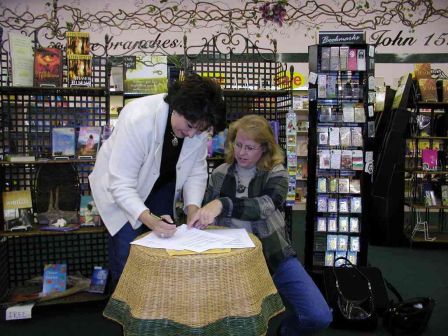
My husband and prayed over the contract wording, made sure we understood all of the clauses correctly, and got advice from an agent I had been corresponding with. In the meantime, Janelle Mowery, my co-author, did the same. Once we were both satisfied, we got together to sign the paperwork. Hands shaking, I put my name to my first ever book contract. A few weeks later, I got a copy of the contract back, signed by a Barbour representative. It was official. I was an author.

I framed my copy. ;-)

Newsletter Subscribe

* indicates required
Email Format

Followers

Powered by Blogger.

Historical Romantic Suspense

Historical Romance

Popular Posts

Recent Posts